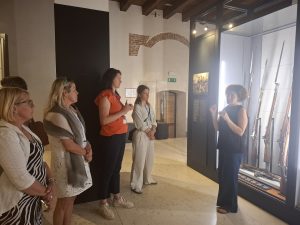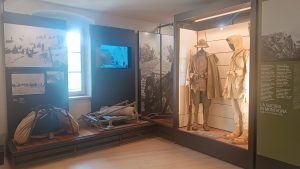
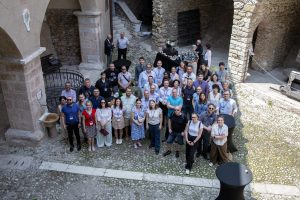
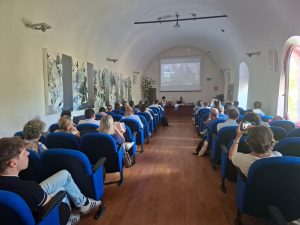
The GOV4PeaCE project, part of the Interreg Central Europe program, held its second joint transnational strategic workshop at the Italian Historical War Museum (MITAG) in Rovereto, Italy, from June 9th to 11th, 2025. This three-day meeting gathered partners and associated partners from eight European countries, all focused on the valorization, management, and study of World War I historical heritage from a united European perspective. The goal was to analyze progress in defining cross-border and multifunctional management models for this significant heritage.
________________________________________
🗣️ Day One: Defining the Future of Heritage Management
The first day was dedicated to project progress, presentations, and active workshop sessions.
Giulio Focardi from OsunWes presented significant advancements on the digital self-assessment tool, designed to help historical sites measure their maturity level in heritage management. This tool is set to be enriched and developed into a user-friendly interface in the coming months.
Later, Dr. Jean-Baptiste Hintjens of the In Flanders Fields Museum, alongside colleagues like Tina Komac (Triglav National Park), Kamil Ruszała (Jagiellonian University), and Stephen Lodewyck (In Flanders Fields Museum), detailed the piloting activities. Their fieldwork tested the emerging governance model in functional regions, with Italian, Slovenian, Polish, and Slovakian stakeholders providing crucial input to refine the model’s efficacy.
In the afternoon, 80 participants divided into five working groups for practical activities, focusing on key outputs:
● Shared Charter of Intentions: The discussion, inspired by documents from organizations like the LRE Foundation (whose process was presented by Dr. Viola Scalacci), focused on the challenge of creating common guidelines for narrating WWI history while respecting diverse national and institutional approaches. The emphasis was on a balanced, nuanced narrative dedicated to peace.
● External Minimal Historical Informational Materials: The group defined ten crucial standards for promotional materials (signage, brochures), stressing clarity, bilingual content (local and English), map inclusion, and rigorous historical accuracy.
● Joint Cross-border Agenda: This session aligned promotional tools with modern trends. The key conclusion was the necessity of a multi-channel strategy segmented by age group, leveraging social media (especially TikTok and Instagram for youth) while maintaining traditional tools.
________________________________________
🏞️ Day Two: The Outdoor Experience at Monte Zugna
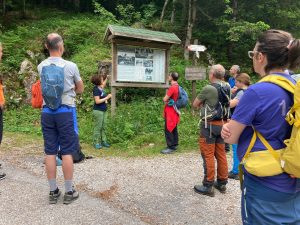
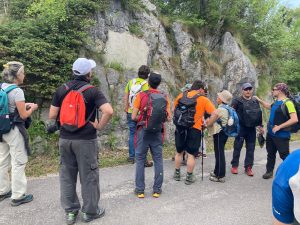
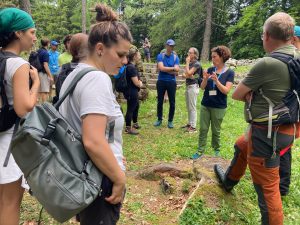
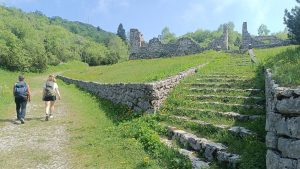
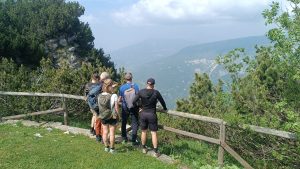
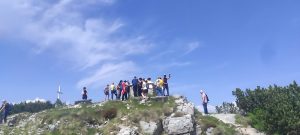
The second day was entirely an outdoor study trip to the historical site of Monte Zugna near Rovereto.
The site, highly significant in the Southern Front of WWI with its vast network of trenches and tunnels, was chosen specifically to highlight the fragilities that can exist despite historical value. Although the site has strengths—clear trails, accommodation, and commemorative importance—it struggles to attract visitors.
Key weaknesses identified included:
● Difficult Accessibility: A road only suitable for small-sized minibuses limits school tourism.
● Lack of Connection: The site is isolated, not linked to other popular hiking routes.
● Missing Community Involvement: There is a noticeable lack of local associations and volunteers, which are deemed essential for the long-term sustainability and vibrancy of non-institutionalized outdoor sites.
The afternoon featured a separate session for partners from Slovakia and Poland, who, with expert Lorenza Salati, planned their next steps for piloting the governance model in their regions.
________________________________________
🤝 Day Three: Strategic Planning and Future Horizons
The final day began with a successful public event.
Dr. Viola Scalacci (LRE Foundation) emphasized the value of a participatory, collaborative approach in cross-border projects, stressing the need to allow for national singularity within shared paradigms.
The discussion then turned to achieving international recognition. Dr. Frank Viltart (Service Chemin des Dames et Mémoire) shared the valuable experience of the Franco-Belgian cemeteries’ UNESCO World Heritage application. This inspired the Gov4PeaCE partners, as Irena Mars (Slovenian Ministry of Culture) expressed the aspiration to build an international network of WWI paths.
Dr. Marco Marinuzzi (EGTC of Gorizia) concluded the morning with practical guidance on application processes, outlining an ambitious plan: defining quality standards, expressing willingness to nominate paths by late 2026, and a formal submission by autumn 2027.
The conference concluded with the Italian-Slovenian functional area partners meeting to plan their piloting activities, focusing on transnational strategies and potential involvement in the Cultural Routes of the Council of Europe, reflecting the higher maturity level of governance in their territory.